|
The ruins of Dirleton Castle are set in one of the prettiest villages in Scotland. When we visited it on a sunny April day the spring flowers were a blaze of colour.
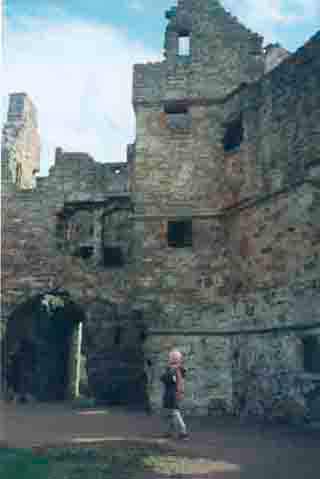 |
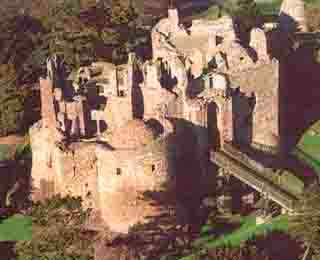
The original castle was built in 1239 but was overcome in 1298 by Anthony Bick, the fighting Bishop of Durham, in one of Edward 1st forays against Scotland. It was rebuilt over the next century as a cluster donjon. It had three towers, two circular and the square one dating from the first building. They were built round a triangular courtyard and the whole conformed to the contours of the ground and was strengthened by the addition of a deep moat, at least 50 feet wide, a moveable wooden bridge resting on four piers, and the castle further defended by a drawbridge spanning the moat.
These innovations were not acceptable to the Ruthven family who acquired the castle in 1515 and built an up to the minute Renaissance mansion beside the old buildings. They however forfeited the castle to the Crown after being implicated in an attempt to assassinate King James VI. |
 |
In spite of the enormous amount of defence work put in on the castle Generals Monk and Lambert attacked it and overcame the resistance. Three of the leaders of the moss garrison stationed within were hanged from the walls as a lesson to others.
General Cromwell also managed to have a go at the beautiful and apparently impregnable castle, starting a bombardment at noon and entering the castle in time for tea. In spite of its stormy history the ruins are still an indication of the power and strength of the building customs of the day. |
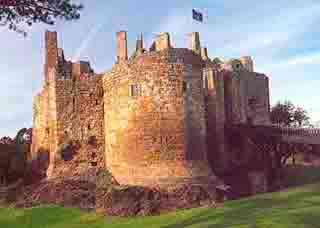 |
Massive and broody the castle towers over the grounds and churchyard, putting in the shade the lovely little village straggling round its base.
The gravestones round the square towered church bare mute testimony to the length of time the buildings have been in existence, still there to this day although the inscriptions on a lot of the gravestones are indecipherable. The grounds are immaculately kept and beautiful to see, belying the tales of violence, treachery and death that are part of any old building. |
| There is a village green around which are an art gallery - showing works of local artists - a tearoom, pottery and knitwear. Listening to a story of Macbeth by Nigel Tranter made the juxtaposition of ancient and modern even more poignant, and although the sun was shining we left, reflecting on the horrors Scotland has endured and inflicted in the space of some eight centuries. |
Please contact the editor@anAurora.co.uk with any stories or features that you would like us to publish for
you.
Top |