"The Internet
Magazine for the disAble Woman. The 'dis'
is small, it's the Ability that Counts".
We have been delighted by your responses, keep the articles
flowing. We have been delighted by your responses, keep the articles flowingWe
have been delighted by your responses, keep the articles flowing. Arts
paintings from the artist Dollner and the Arts
Council England funds two new commissions at Liberty festival.
In Beauty and Fashion there are
a few hints to take the best care of your skin and get that radiant glow. Florence
our resident beautician answers your questions
Features Cringletie House wins Scottish
Hotel Accessible Room award 2006. Garnet
Access Project exists to promote disabled access to the countryside
using quad bikes and amphibious six-wheelers. Mary rises to the Extra
10th State Street Caledonian Challenge
Fiction contains two short stories, and a light hearted
horoscope for October, November
and December.
Food recipes containing Asparagus,
how to cook and eat them property, described by our food expert Pade Ross from
her villa in Spain.
Violet Lutea is here once again with her helpful gardening
tips.
Health: Advice from Jeni.
Regulars: the links page increases each issue, and
our Quizzes become easier!
Quarterly Quote: Walking on Wheels
Review of Walking
on Wheels, by Eva McCracken
It is apparent right from the start
that this little book about walks for disabled people is written by someone
who knows what they are doing. Inside the front cover is a very useful key to
the suitability of routes – easy, shown on the maps by blue dots, difficult,
in yellow and challenging, in red. Not just the surface, but the things able-bodied
walkers may not think about much – or at all, like gradients, cambers
and width; not much use being a flat tarmac surface if you can’t turn
your wheelchair or scooter around.
As a new wheelchair user I am learning how much these things
matter; a recent visit to a Perthshire beauty spot I remembered well from my
hill walking days as a nice flat track had to be abandoned because what were
quite small stones in my walking days now became mini-boulders, and in Portugal
last year the charming cobbled streets took on quite another aspect as I bumped
and jolted over them. Having been frustrated in Perthshire, this book has come
like a shot in the arm, and I look forward to trying out some of the walks.
The book is born out of the determination of
the author, Eva McCracken, not to abandon the delights of her beloved hill walking
once she was confined to a wheelchair. She has listed fifty walks in Scotland
in seven different areas, and has carefully audited all of the routes in the
book to a very high standard, not only for the suitability of the trail but
for many other factors that disabled people will need to know. Each page has
a description of the walk and map references, distances, availability of toilets
(even whether there is room for a wheelchair to the right or left of the toilet)
with website details and/or telephone numbers of relevant organisations and
people – Forestry Commission, Visitor Centres, Rangers and Access Officers,
for instance. On the facing page there is a map of the area, showing the walk
marked as easy, difficult or challenging (no such thing as very difficult, I
noticed!) and a photograph. Some walks are through forested areas, some through
more open country, some along canal towpaths, all with detailed notes where
necessary about access, gates, and roads which may need to be crossed. I was
very impressed by the walks around the Loch Morlich area in the Cairngorms,
where I often walked in pre MS days; not only were they well covered, but I
found a track I did not know about, and more to the point found I could borrow
a scooter from the Visitor Centre! I thought my days on the Glenmore Forest
tracks were just a wistful memory, but thanks to this book I shall be back there
again as soon as possible. Thank you, Eve McCracken. Many disabled lovers of
the outdoors will bless your name.
I have looked to see what could be in the book that has been omitted, but cannot
find anything, other than the understandably limited coverage. It would be good
now if other wheelchair walkers were to audit paths in their area and pool the
information for a second edition, but it would be very important to maintain
the same high standard. I am sure that not only will there be a demand for a
second and enlarged edition, but a clamour from south of the border for someone
to do the same for England.
The book is published by the Cualaan
Press, ISBN 0-9544416-8-0, and costs £10.99
Proceeds are going to the Walking on Wheels Trust
John Berridge
anAurora readership
increases daily and has already reached Argentina, Australia, Austria, Belgium,
Brazil, Canada, China, Denmark, France, Germany, Hungary, and India. Ireland,
Israel, Italy, Japan, Malaysia, Mexico, Netherlands, New Zealand, Norway, Portugal,
Russian Federation, Saudi Arabia, Spain, Sweden, UK and the USA, which is fantastic.
Please, continue to support anAurora by sending in
your articles to: editor@anAurora.co.uk
If you are not using Internet Explorer, and the title of
any page goes askew, click on the Reload or Refresh button to sort it out!
If you want to try out another edition of anAurora,
click on the pull-down menu at the left of the page and make your selection.
To move from one edition to another, please use this pull-down menu from now
on.
We have the facility for you to read Text
as many of us still use browsers which are not able to recognise pictures. The
icon is at the top of each page. As yet we still have no sound but are working
on this.
Please feel free to sign the guest
book as well as continuing to send your emails and articles,
your poetry and stories.
Last date for articles to go into the next issue is 1st
November, 2006, email them to editor@anAurora.co.uk.
All articles will be available in back issues for a minimum of two years. Some
issues since Spring 2000 have been withdrawn, but if you would like us to email
you an electronic copy please email your request to editor@anAurora.co.uk.
The file is quite large, and you should be sure that your email provider will
allow you to download a file of 3Megabytes in size.
The views expressed in this magazine by readers are personal
and not necessarily those of anAurora, but she will not print
any offensive material regarding ability, creed, race, religion or gender.
The contents of this Internet Magazine may be reproduced
without seeking permission from anAurora, but please mention your
source.
This is a free magazine, in that anAurora
is not supported in any way by either charity funds or advertising, and she
would like to keep it that way. But the Magazine will dry up after a short time
unless you contribute your articles.
anAurora does not have a "Mission Statement"
but her intention is to continue to develop, with your help, a magazine that
women with any disAbility can contribute to and read with enjoyment.
Goodbye until December!
Liberty,
the UK’s largest disability rights festival, returns to Trafalgar Square.
The Artist Dollner
is back with more of her paintings.
If anyone would like to send some of their own poetry, paintings,
and crafts, etc, please contact: editor@anAurora.co.uk
Artist
Dollner
Happy Holidays!
I was looking for my site listing on your site and it seems
to be something wrong so I am sending you this one to list again.
Please take the old one down as it is not working anymore.
"DOLLNER"
Dollner
Johnston Website
The Artist Dollner pictures are in the graphics version
here.
If anyone would like to send some of their own poetry, paintings,
and crafts, etc, please contact: editor@anAurora.co.uk
Arts
Council England
Arts Council England funds two
new commissions at Liberty festival
Liberty,
the UK’s largest disability rights festival, returns to Trafalgar Square
for the fourth time with a strong line up of street arts, theatre music and
dance that is aimed at everyone.
For the first time, the festival has received
Arts Council England funding, which has enabled the commissioning of two new
works by leading disabled performers - Priscilla Queen of the Deaf
World by The Alexandras and Elevation
by Caroline Bowditch.
The commissions are designed to counter the
historic under-representation of disabled artists in the UK street arts sector
and it is hoped that the works will have a continued life after Liberty.
Priscilla Queen of the Deaf World features
the creative talents of leading sign song artist Caroline Parker, who has been
delighting audiences with her interpretations of classic songs such as Bohemian
Rhapsody and her recent tour Signs of a Diva.
Directed by Jenny Sealey of Graeae
Theatre, Priscilla
Queen of the Deaf World is a high impact performance featuring
Caroline Parker, Mark Smith and Daryl Jackson using sign song, elaborate costumes
and evocative entrances to catch the eye of the public and reflect the Deaf
view of the world, life and emotions.
Elevation
by Caroline Bowditch is a new piece of dance specifically created for Trafalgar
Square. Exploring the concept of elevation in terms of the practical (movements
of the performers), physical (structures within Trafalgar Square) and political
(disabled people needing to be recognised and given equality) the work invites
the audience to aim high and personally experience the power and value of rising
upwards. Using movement, sound and images, Elevation will challenge, excite
and amuse.
Along with the presentation of Miniatora,
by internationally renowned integrated dance company CandoCo,
these new inspirational site specific performances on Trafalgar Square will
complement Liberty's stage based programme.
Ken Livingstone, Mayor of London, who organises
Liberty in conjunction with Deaf and disabled Londoners said:
'Liberty is part of my efforts to make London an accessible and inclusive city.
Deaf and disabled people make up more than 20 percent of London’s population
and it is important that their contribution is celebrated. Liberty is now the
largest disability rights festival in Europe and the exciting new commissions
featured this year build on this success. Liberty offers an array of acts –
from street art to rock – that all Londoners and visitors can enjoy.'
Sarah Weir, Executive Director of Arts Council
England, London, said:
‘We're delighted to be supporting two new commissions at this year's Liberty
festival, which will contribute to a dynamic body of wide-ranging and provocative
street art. Liberty is a key opportunity for Londoners to experience the wealth
of talent and creativity of disabled artists, as well as promoting disability
equality in the capital and beyond.’
In addition to the new commissions, artists
such as New York born vocalist Marlo Donato, the bands
Beat Express, FreeSlave
and The Heroes and mime artist Ramesh
Meyyappan are also due to perform at Liberty.
Arts Council funding has also contributed
to the setting up of a Liberty seminar programme later in the year, which will
focus on good practice for access at festivals and training placement opportunities
for disabled people www.london.gov.uk/mayor/equalities/liberty/index.jsp.
LINE UP INCLUDES
Carousel present dance company High Spin
in a high energy duet 'Crush Proof'
Carousel present four piece rock band Beat Express
Candoco present Miniatora, a newly commissioned contemporary
dance piece set within a giant inflatable architectural structure
Up and coming band Freeslave led by songwriter Haydon
Spenceley feature material from their new album
Ramesh Meyyappan presents his acclaimed mime performance
'The Insomniac'.
Ramesh Meyyappan also performs 'Lazzi of Hunger', a street theatre performance
in the Comedia del Arte style.
Caroline Bowditch presents world premiere of Elevation,
a site specific dance piece
New York born vocalist Marlo Donato performs with her musicians
Creative Routes present innovative multi-media music
theatre performance
Kickin’ Kangaroo present a club based dance
set designed to encourage everyone to participate
Johnny Crescendo and Andy Morgan
perform protest songs
The Alexandras present world premiere of Priscilla
Queen of the Deaf World
The Heroes perform hard-hitting pop music fused with
strong social awareness
ACCESS INFORMATION
Liberty is a festival for everyone and is organised to be
inclusive and accessible. The following facilities and services on the day will
include:
-
Information points
-
Trained stewards ad BSL interpreters
-
Programmes in large text and Braille
-
BSL interpretation and palantype relayed onto large
screen
-
Audio description
-
Accessible toilets
-
Changing area with hoist
-
Viewing area
-
Induction loops at information points
-
Wheelchair loan service
-
Charging Point for electric wheelchairs and scooters
Assistance dogs area
-
Lifts
-
Free mobility bus between Westminster Tube and Trafalgar
Square, courtesy of Metroline
-
Free parking nearby for blue badge holders - Limited
availability - Advance booking only 020 7983 4094
If you are an artist with some work to share, would you
like to send some of it to us? Email editor@anAurora.co.uk
This section has a Q and A page on beauty tips and information
on how to look your best by paying attention to diet and leading a well-balanced
life.
Remember, if you have any fashion and beauty tips or ideas or know someone who has, please contact editor@anAurora.co.uk
Beauty Bits
Hi, how often would you suggest I soak my fingernails
in Olive Oil? They keep flaking.
Regards, Liz
Liz, you should go to a beauty salon and have a paraffin
wrap. Apparently the effect lasts for ages. Paraffin wraps also help ease
arthritis pain.
Florence
Hi
How can I get my hair to look good while on a beach?
Regards, Ann
Ann, if your hair is short, comb it back and tuck
it off your face behind your ears using If your hair is longer sleek it back
into a bun securing all the stray hairs away from your face
Florence
Hi
I am soon to be married but I can't find a hair style that suits me. I have
grown my hair to shoulder length?
Regards, Tina
Tina, over the next week or two flick through some
magazines and rip out anything that you think you may like. Next, book a consultation
with a good hairdresser and ask for their professional advice. If you do opt
for an up hair style it has the benefit of staying in place all day without
you having to worry about it.
Florence
Remember, if you have any fashion and beauty
tips or ideas or know someone who has, please contact editor@anAurora.co.uk
Beauty Tips
1. Eat a balanced diet – what we put in our bodies
will show
on our skin. If you eat fatty foods and junk your skin will reflect that,
so give your skin proper nutrition.
2. Get at least 7 to 8 hours sleep every night. A lack of sleep will show
up under your eyes as dark circles or bags. Proper rest will also benefit
your body and your life.
3. Drink 6 to 8 glasses of water a day to keep your skin hydrated. It is best
to spread the consumption of water in small amounts over the course of the
day to be sure it is properly absorbed.
4. Maintain a regular exercise schedule. Exercise gets the blood moving and
creates a healthy body.
5. Get lots of fresh air but avoid prolonged exposure to wind and cold.
6. Avoid the sun and tanning beds. The damage done by
ultraviolet rays is long lasting and cannot be reversed.
7. Always wear sunglasses to avoid squinting.
8. Try to achieve a well-balanced life and reduce stress.
9. Exfoliate twice a week to rid your skin of dead cells.
10. Develop a skin care routine for your particular skin type.
Remember, if you have any fashion and beauty
tips or ideas or know someone who has, please contact editor@anAurora.co.uk
The first article describes prize-winning Cringletie
House for its accessibility and excellent facilities for guests
with various disabilities.
Next comes a short article describing wordtalk,
which is very helpful to visually-impaired people while using their computers.
A short note about the Rail Passengers Committee Scotland,
which aims to build up a network of information for all travellers, is followed
by a course offered by Community Enterprise to make SORP (State of Recommended
Practice for Accounting) more understandable, including a website giving information
on training dates.
Next, Wheelchair Review seeks
the comments of people who use or provide wheelchair services in Scotland.
A researcher on The Making of Modern Motherhoods
is seeking information from disabled mothers to be included in mainstream
research, with contact information.
Next comes an invitation to participate in a test session
which will enable researchers to compile information on accessing the web.
Youth Awards invites nominations
for young people who have done something deserving of an award.
An inspiring article by Mary Guild
follows, about disabled entrants to the West Highland Way challenge and how
all monies raised benefits charities.
Please contact the editor@anAurora.co.uk
with any stories or features that you would like us to publish for you.
Cringletie
House
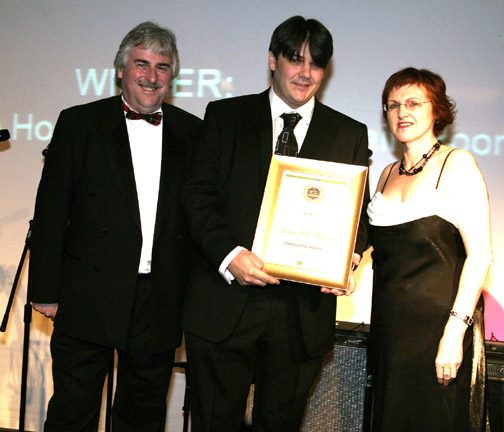
CRINGLETIE HOUSE WINS SCOTTISH
HOTEL ACCESSIBLE ROOM AWARD 2006
Cringletie
House has been announced the winner of the
Scottish Hotel Accessible
Room award at the prestigious Scottish
Hotels of the Year Awards 2006. The award was presented
on Sunday 23 April and recognises the outstanding design applied to access,
comfort and style for disabled guests provided by Cringletie
House in Peebles, Scottish Borders.
This award closely follows praise given to Cringletie
House by Anne McGuire, Minister for Disabled People, for
the recent renovations carried out to ensure easy access for disabled people.
Anne McGuire cited Cringletie
House as a good example of how businesses can improve their
customer service.
Changes that have been made to Cringletie
House include access to the main entrance being levelled
and a ramp installed to the doors. An induction loop is fitted at reception
and a portable device can be used elsewhere in the hotel, plus one ground
floor room has been designated for disabled people.
This specially equipped room includes a sensor to gain
access to the room as some people with co-ordination impairment find it difficult
using a traditional key; and the wooden flooring enables moving around the
spacious room easy. There is also room to recharge power chairs.
If the fire alarm sounds, lighting is activated in the
room to alert deaf guests to evacuate the building. Vibrating pillows are
also available to warn people with hearing impairment of an emergency. The
bathroom has a roll-in shower facility, a shower seat, low level sink and
grab rails.
Johanna van Houdt, proprietor of Cringletie
House comments; ‘We’re thrilled to be presented
with this prestigious award as it’s always great for the work and dedication
of our team to be recognised. We’ll continue to provide excellent service
for all our customers and maintain the high standards we have set for disabled
facilities and services at the hotel.’
Cringletie
House is set in 28 acres of gardens and situated in the
heart of the Scottish Borders only 40 minutes drive from Edinburgh. This romantic
baronial mansion was also recently awarded three red stars from the AA, making
it the only hotel in the Scottish Borders with such an accolade and is listed
amongst the AA’s Top 200 hotels in Great Britain and Ireland with its
restaurant retaining two AA rosettes since 2003.
The hotel was very highly commended in The
Scottish Country House Hotel of the Year and The
Scottish Hotel Chef of the Year categories. It was also a finalist
in the Scottish Hotel of the Year Award 2006.
For enquiries or reservations please contact:
Cringletie House
PEEBLES
EH45 8PL
e-mail: enquiries@cringletie.com
call: 01721 725732
visit: www.cringletie.com
For further media information please contact: Fiona Vernon
or Caroline Smith at Niche Works on 0131 467 4241 or fiona@nicheworks.co.uk
/caroline@nicheworks.co.uk
Please find attached a press
release highlighting Cringletie House’s success on
Sunday 23 April at the Scottish Hotels of the Year Awards 2006
where they won the Scottish Hotel Accessible Room Awards 2006.
This follows recent praise from the Minister for Disabled
People, Anne McGuire, for the renovations carried out at the hotel to ensure
easy access for disabled people.
If you would like any images or further information,
please don’t hesitate to contact me on 0131 467 4241 or e-mail me at
caroline@nicheworks.co.uk
Many thanks,
Caroline
Niche Works
T: 0131 467 4241
F: 0131 467 4248
E: caroline@nicheworks.co.uk
W: www.nicheworks.co.uk
Please contact the editor@anAurora.co.uk
with any stories or features that you would like us to publish for you.
Feature
Facts
Adding Text to Speech
to MS Word
Word
Talk is a 'plug in' template that adds text-to-speech to
Microsoft Word for Windows®. Research and experience has shown that students
with visual or reading difficulties can find it very helpful to have text
read out by the computer.
Supporting reading and study through ICT also offers greater
independence and a useful life skill rather than relying on a human reader.
Word
Talk was developed by Rod Macaulay at TASSC in Aberdeen
and the Scottish Executive Education Department and has been distributed on
CD free of charge to secondary schools in Scotland.
The program was formally launched in September at a series
of presentations. It can be downloaded free of charge from the Word Talk website,
www.wordtalk.org.uk.
As the installation file is very large we would strongly recommend using broadband
or a similar fast internet connection. If you can only access a slow dial-up
connection, the CD can be obtained from:
The Rail
Passengers Committee Scotland (RPCS) is the official, independent,
voice of the travelling public. Together the Rail Passengers Council and Committees
make up the RPC network, representing all passengers on the UK rail network.
We consult and listen to passengers to work for improvements
to rail services that will benefit all passengers.
Our aim is to build a passenger survey/questionnaire website so that we can
survey and provide feedback to passengers in Scotland on specific issues and,
to inform our work. We are in the process of setting up the website and will
be in touch with you again shortly to request information and provide further
details.
http://www.railpassengers.org.uk
The Statement of Recommended Practice (SORP) for Accounting
and reporting by charities has recently been revised and applies to all but
the very smallest charities.
Community
Enterprise offers a course to provide a comprehensive overview
of SORP 2005, giving easily understood information for the non-accountant
on the formats and information to be provided in a set of SORP compliant accounts.
The emphasis is on demystifying the jargon and picking out the relevant information
from the 110 pages of SORP guidance.
For information on future SORP training dates contact
Pamela at Community
Enterprise.
email : pamela@communityenterprise.co.uk
National Wheelchair Review of NHS
Wheelchair Services in Scotland
A review of NHS
Wheelchair and Seating Services in Scotland has been published,
following a consultation exercise seeking the views of all people involved
in using or providing wheelchair services across Scotland.
The remarks of the chairman, Professor Martin Ferguson-Pell,
can be read here.
My name is Erin Shamberg and I am part of a group of volunteers
who have developed an online community site called Dating4Disabled.com.
This site is aimed at helping disabled individuals develop
their social, personal and romantic life in a supportive and understanding
environment. We offer forums, private chats, a dating service and blogs, among
other features, to facilitate personal expression and connection via an on-line
community.
We feel it is important for persons with disabilities
to have more opportunities for social and romantic interaction. Our site is
totally free and non-committal.
All the features can be seen at the website without becoming a member. Just
click on the orange feature buttons on the left hand side of the screen.
Dating4Disabled.com
was developed by a group of volunteers who wanted to provide more social,
intellectual and romantic outlets for disabled individuals. This growing community
has become a gathering place for the international special needs population,
home to members from over 15 countries world-wide. It is a place for people
of all nationalities, backgrounds and life-challenges to share, connect and
just be heard.
The Dating4Disabled
environment is welcoming and user-friendly. Advanced internet tools make for
easy communication, and facilitate a convenient and fun way to create connections
within the disabled community. Members can come together through forums, a
dating service, private chats, and blogs, among other features, providing
people with mobility issues the opportunity to fulfill their social needs
from the convenience of their own home. The site has also incorporated large
font options and supporting icon comments to assist the visually challenged.
The members of Dating4Disabled
can network internationally in an understanding, safe and non-committal atmosphere.
This unique cyberspace community facilitates an embarrassment-free opportunity
for disabled individuals to express themselves, make friends, and hopefully
find a partner for life, with out the pressure of uncertain face-to-face meetings.
The support and understanding available in the dating4disabled
family makes for an exciting new "home away from home".
Our free membership is simple and quick. In the 2-minute
sign-up, people create a profile which tailors their online preferences and
enables other members to know more about them and what they are looking for.
One can customise their interactions by type of relationship, life-challenge,
location, interests and more.
All these tools and features provide an enjoyable and
valuable online experience. The potential for net-working, meeting new people
and creating relationships is unlimited. Dating4Disabled
provides its members with the opportunity to utilize the World Wide Web for
their own unique needs, and to open windows of possibility to the international
disabled community.
Best Wishes,
Erin Shamberg (201) 984-5912
erin@dating4disabled.com
The Dating4Disabled Team
www.dating4disabled.com
Hi,
I really hope you can help me. I came across your website whilst searching
through disability forums. I am a researcher at The Open University and also
a part- time PhD student.
I am working as part of a team on the project The
Making of Modern Motherhoods. This project is a very prestigious
academic research project funded by the ESRC
and is looking at women's experiences of first time pregnancy and ideas of
motherhood with the aim to compare different women's experiences and changing
experiences over time (looking at differences from previous generations).
Prior to this project I have done a lot of youth work
and research/consultancy work with young disabled people.
My interest in disability lead me to start a PhD part-time
at The Open University which is focusing specifically on disabled women's
relationships with their bodies in pregnancy and Your website looks great
- I wondered if you could give me any advice about trying to find women to
take part in the Making
of Modern Motherhoods project?
I am currently posting messages on forums but I wondered
if this was appropriate for your website? Do you know of any organisations
and groups in the UK who may be interested in helping me? I am really keen
to find women for The
Making of Modern Motherhoods project as I think it is important
that disabled women's experiences are not left out of mainstream academic
research. (It would involve filling in a questionnaire and being interviewed
in their home.)
You can contact me or leave a message on: 0208 855 4774
or by e-mail: l.s.hadfield@open.ac.uk
Lucy Hadfield
Research Fellow
The
Making of Modern Motherhoods
FHSC
The Open University
Walton Hall
Milton Keynes
Dear Sir, Madam,
Within the framework of the BenToWeb project:
www.bentoweb.org,
ISdAC
International Association is looking for test users.
BenToWeb
(Benchmarking Tools and Methods for the Web) is a European project aimed at
supporting the development of an accessible Web environment.
In order to be able to ensure the accessibility for the
different target groups, BenToWeb wishes to call upon the user expertise of
people with varying disabilities. By means of a user test we want to investigate
the accessibility of the BenToWeb developments.
The first test sessions will take place in March. The
actual test consists of a series of about 20 short exercises and will take
about 30 minutes of your time. You can attempt the exercises at home or work
by accessing our website.
Test participants receive a reimbursement for each completed
test series of 20 exercises by means of purchase vouchers by choice (e.g.
Amazon, Tesco, Carrefour...) or an equivalent amount.
If you are interested in participating in this test,
and you have at least 30 minutes of time available in March, we would like
to invite you to fill out the short questionnaire at:
http://bentoweb.org/amfortas/
We require this information (name, age, assistive technology
used,) so that we get an idea of how you access the Web. This data will be
kept strictly confidential and will not be passed on to third parties. It
will only be used internally for statistical purposes.
Unfortunately, registration doesn’t guarantee we
can accept you as a test user as we require a panel of users who represent
the disabled community at large. It is possible that your user profile doesn’t
match the specific profile(s) we are looking for in the first test series.
However, more tests
will follow and you may then be contacted for future test sessions.
As soon as you have registered we will contact you personally
in order to inform you if you have been selected and for further arrangements.
Test users that are already registered at the ISdAC
database need to register again through the link above. It is technically
impossible to automatically link the individual data of interested test users
to the BenToWeb user profile questionnaire. Furthermore,
in order to safeguard the
privacy of the registered ISdAC
test users we do not wish to pass on this data to the BenToWeb consortium.
If you have any more questions, please don’t hesitate
to contact us. Also, don’t hesitate to pass on this mail to anyone else
that might be interested.
Thank you!
Kind regards,
Tony Verelst
Chairman ISdAC International Association
c/o IGL
Boddenveldweg 11
B-3520 Zonhoven
Tel. +32 11 819465
Fax +32 11 271622
Direct phone +32 11 720012
E-mail : Chairman@isdac.org
www.isdac.org
Indepen-Dance
is offering a dance training day with award winning physical theatre company,
Earthfall
29th September 2006
5 Langside Avenue
Glasgow
G41 2QR
Earthfall
are a physical theatre company based in Cardiff. They tour nationally and
internationally and have gained a solid reputation for their extensive performances
and work with schools throughout the UK and overseas.
The workshop will provide a unique chance for you to
learn new and relevant skills with the area of dance theatre.
The areas of focus for the workshop will be partner work,
physical theatre, contact improvisation and contemporary technique.
This course is aimed at social work staff, care workers
dancers and those using dance/movement in a community setting workshops are
practical therefore please dress appropriately.
Cost £30 (£25 conc) limited free places for
GCC staff
To book a place contact:
Claire Mitchell
Dance Manager
Tel 0141 248 5525
Mob 079808455525
Email indep_dance@hotmail.com
Supported by The National Lottery
and Scottish Arts Council
Please contact the editor@anAurora.co.uk with any stories or features that you would like us to publish for you.
Garnet
Access Project
Garnet
Access Project exists to promote disabled access to the
countryside using quad bikes and amphibious six-wheelers.
My name is Jon Heasman and I have been in a wheelchair
for the past six years. I spent the first year gazing at the countryside where
I used to walk so often, thinking " I'll never go there again."
I then decided to change this dire situation. I am now
in a position to show you how you can do this for yourself. These vehicles
can take you there, whatever the terrain and whatever your disability.
Please contact the editor@anAurora.co.uk
with any stories or features that you would like us to publish for you.
Junior
Crew
There are two contributions to the Junior Crew in this
edition, an introduction to the Global Youth Awards, and the Junior Quiz.
Also, we have the answers to the Adult Quiz.
GLOBAL
YOUTH AWARDS
Hi there, I would like to introduce you to:
Global
Youth Awards
We will like to personally invite you to nominate a young
person whom you believe has done something truly remarkable and is deserving
of an award. As part of the first truly Global
Youth Awards we are seeking nominations from around the
world for such young people.
Nominations are straightforward and won't take 5 minutes
of your time. There is no charge for submitting a nomination and you can nominate
as many as you believe deserve an award.
To nominate a deserving youth please go to:
www.globalyouth.net
We appreciate your time and cooperation in helping us
find the best of the best.
Yours sincerely,
John Sebastian
Awards Team
jsebastian@globalyouth.net
JUNIOR QUIZ
Here is our Junior Quiz. The answers are in the Regulars front page. Click here
| 1 |
What does the Roman Numeral V equal? |
| 2 |
Which is the higher belt in Judo: black or yellow? |
| 3 |
What is the key ingredient of an omelette? |
| 4 |
How many hours are there in TWO days? |
| 5 |
In what structure would Clark Kent visit to change into Superman? |
| 6 |
How many years have a couple been married when they celebrate their
SILVER wedding? |
| 7 |
What does the French word bonjour mean? |
| 8 |
How many ten pence pieces are there in twenty pounds? |
| 9 |
Emulsion and enamel are types of what? |
| 10 |
Used in World War II, what sort of device were U-boats? |
ADULT QUIZ: ANSWERS
| 1 |
Who wrote Not a Penny More, Not A Penny Less?
... Jeffrey Archer |
| 2 |
Which member of the Royal Family married Serena Stanhope?
... Viscount Linley |
| 3 |
Nat King Cole in 1957, Donny Osmond 1973 and Rick Astley in 1987
all recorded the same song. Which one?
... When I Fall In Love |
| 4 |
What was the name of the prostitute with whom Hugh Grant was arrested
in Los Angeles in 1995?
... Divine Brown
|
| 5 |
What is 4 cubed minus 8 squared?
... Zero |
| 6 |
Who made Who's Who for the first time in
1991 listing his hobbies as football, snooker, pigeon racing and darts?
... Andy Capp |
| 7 |
James Callaghan in 1977, appointed his then son in-law as Britain's
Ambassador to Washington. Name him.
... Peter
Jay |
| 8 |
Which word can mean any form of transport and the legal term for the
transfer of property by way of deed?
... Conveyance |
| 9 |
Which breed of dog is called "The King of the Terriers"?
... The Airedale |
| 10 |
What is the three dimensional image created by laser beams called?
... A Hologram |
Please contact the editor@anAurora.co.uk with any stories or features that you would like us to publish for you.
Rising
to the Extra Challenge
Rising to The
Extra Challenge
by Mary Guild
Just imagine – nearly 10,000 people of all shapes
and sizes trekking en masse along a gruelling fifty-four mile stretch of some
of the most beautiful, rugged terrain known to man. Some slog.
Cue 14 June 2006 - and the 10th State Street Caledonian
Challenge along the West Highland Way. Fort William to Loch
Lomond non-stop. Scotland’s number one endurance, fund-raising event.
Cue, too, the accompanying Extra
Challenge – an accessible eight-mile long haul across
this same West Highland Way – for disabled entrants only. But forget
any fond misconceptions of a light stroll in the park. This is seriously stiff
outdoor stuff too. Just ask The Intrepid Twenty – the score of disabled
adventurers who signed up this year – including three BPF members and
seasoned ramblers, Helene McLean, Heather Macdonald and myself – not
forgetting Inverness
Shop Mobility who generously delivered and collected the
requisite scooters, and our trusty group of experienced, able-bodied walkers
on hand lest our batteries pack in and we need a push!
The
Extra Challenge begins with a straightforward three-mile
run along a scooter/wheelchair-friendly tarmac road. Then the real test begins
– a five-mile obstacle course, encompassing rough terrain, potholes,
and an Inverness-Edinburgh railway crossing, culminating in an undulating
path by some breathtaking forests, lochs and mountains from Bridge of Orchy
down to Tyndrum. Add for good measure an incessant struggle with the resident
rampaging midges ever launching heavy, unprovoked assaults on any unprotected
skin – including ones derriere during a comfort stop at one of the many
Port-a-loos en route!
The Caledonian
Challenge – and its sister Extra
Challenge – though, isn’t just an energetic
jolly. It’s about funds as well as fun. Alongside the mud, sweat and
tears, the banter and the blisters is charity – and the chance to make
a difference and give something back. It all started a decade ago when a group
of seventeen undaunted souls climbed some munros to collect cash for The
Scottish Community Foundation. Next target was The West
Highland Way, and it’s mushroomed ever since, as thousands annually
undertake the 54-mile odyssey to raise millions for charities and communities
across the land.
Oh, and one can’t omit the pre-hike Pasta Party
– a Friday night orgy of carbohydrate overloading, cramming the calories
in a convivial social setting in eager anticipation of the day ahead.
And, yes, we did finish the course! Check the medals
and the T-shirts to prove it! And what an immensely satisfying and fulfilling
experience it all was, the ideal opportunity to get out and about and enjoy
some awesome scenery – whilst helping fill the coffers of many of our
most deserving good causes. Each contestant’s entry fee raises £10,
to which the sponsors will donate £20 to a UK disabled charity of the
participant’s choice.
Fancy a shot yourself? If you’re interested in
doing The
Extra Challenge in 2007 please contact:
Fiona Lindsay
Chartered Physiotherapist and Event Organiser
Tel: 0131 524 0350
Email: Fiona@scottishcommunityfoundation
Fiona will be delighted to provide you with all the necessary
information. Go on! Rise to The Extra Challenge!
Please contact the editor@anAurora.co.uk
with any stories or features that you would like us to publish for you.
This begins with a short, amusing tale, pointing out the
fact that we cannot please all of the people all of the time, followed by
the tail (?) of a poor feline who underwent a terrible "trimming"
ordeal and lost most of her coat due to a misunderstanding.
The section ends with our Horoscope
for October, November and December.
If you enjoy writing, and have a story, poem or narrative that you would like to share, send them to editor@anAurora.co.uk If you wish to attach a drawing or sketch, then so much the better!
Careful
with your Donkey
An old man, a boy and a donkey were going to town. The
boy rode on the donkey and the old man walked. As they went along they passed
some people who remarked it was a shame the old man was walking and the boy
was riding. The man and boy thought maybe the critics were right, so they
changed positions.
Later, they passed some people that remarked, "What
a shame, he makes that little boy walk." They then decided they both
would walk!
Soon they passed some more people who thought they were
stupid to walk when they had a decent donkey to ride. So, they both rode the
donkey.
Now they passed some people that shamed them by saying
how awful to put such a load on a poor donkey. The boy and man said they were
probably right, so they decided to carry the donkey. As they crossed the bridge,
they lost their grip on the animal and he fell into the river and drowned.
The moral of the story? If you try to please everyone,
you might as well ... Kiss good-bye. Have A Nice Day!
(Careful with your donkey)
If you are a poet or a writer with some work to share,
would you like to send some of it to us? Email editor@anAurora.co.uk
Here's
a Cat Story ...
Note: This was not done on purpose (by the pet owner)
and the cat is fine and back to normal.
"My sister-in law is from Oklahoma and has a slight
accent. She has cats and when she lived in the south she would take them to
the groomers and have what is called a Line Cut. To her a line cut is when
all of the fur hanging down below the cat's tummy is taken off (because it
gets matted or snarled).
When she moved to Chicago with my brother, one of the
cats fur got all tangled up during the move so she took it in for a line cut.
She was quite surprised when she heard the price as it was twice as much as
it was down south. She confirmed with the groomer that he understood what
a line cut was and he said, "yes, I know what a LION cut is."
It seems her accent came out sounding like LION not LINE
and this is how her cat was returned to her.
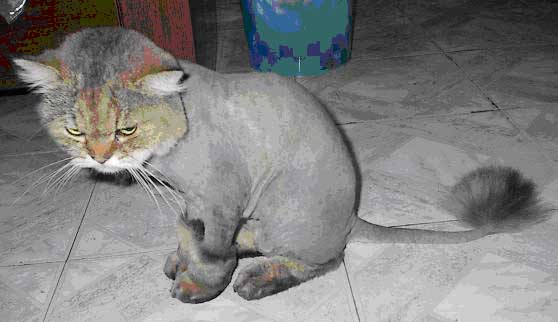
She cried for a week...but not as much as the cat. It
was November in Chicago and the cat needed all the fur it had."
| Gas in car to go to groomers |
$ 4.50 |
| Cat car carrier |
$32.99 |
| Grooming fee |
$80.00 |
Getting the look from one seriously p*ssed off cat Priceless
!
If you are a poet or a writer with some work to share,
would you like to send some of it to us? Email editor@anAurora.co.uk
Horoscope
anAurora's horoscope is here with her light hearted view of the stars.
In the Stars
| |
|
LIBRA
24th September - 23rd October
|
Three quarters of the
year has gone, and now the leaves begin to go yellow and gold. Your
wallet has become emptier after the holidays and it is time to save
for the Festive Season. What a life. |
SCORPIO
24th October - 22nd November
|
As the rains begin, and the nights get longer, there are still a couple
of holidays left. Cheer up, it's time for chestnuts, Guy Fawkes, bonfires
and ... was that a gnome you saw down at the river? |
SAGITTARIUS
23rd November - 21st December
|
Christmas day is coming, plenty of hot cheer around a sparkling fire.
So what if it's icy cold outside and white is the colour of the ground?
Enjoy the shortness of the days - they are going to start to get longer
soon enough. |
For those who want a more personal horoscope: Please contact
your local newspaper!
If you enjoy writing, and have a story, poem
or narrative that you would like to share, send them to editor@anAurora.co.uk
If you wish to attach a drawing or sketch, then so much the better!
Pade has excelled herself with three delicious recipes,
all including asparagus, plus a note on the health benefits derived from eating
it.
Cringletie House appears again with another award given
to their Hotel Chef of
the Year, Paul Hart, and information about booking.
A –Z for Happy Bellies
A Wee A –Z for Happy Bellies
By Pade Ross
Extracts from her Receipt Book Asparagus Contains:
Recipes for sensual, caressing, warming, cooling, heartening, comforting,
delicious, exciting, harmonising, smooth, rough, sophisticated, tough, tasty
and easy Food for Friends
The celebration of being alive, large, small, poor, or
rich, Christian, Buddhist, Moslem, Jewish, Japanese or Communist, vegan, vegetarian
or omnivore, together at one table.
Wee Notes
For the “wee notes”, which you can read –
or not - I am grateful to:
Earl Mindell for The
Vitamin Bible and The
Food Medicine Bible
Thorsons, for The
Complete Guide to Vitamins and Minerals Prevention for New Foods for Healing
Dr. Christina Scott-Moncrieff for The
Vitamin Alphabet
Michael van Straten and Barbara Griggs for Super
Foods
Phyllis and James Balch for Prescription
for Nutritional Healing
Arnold and David Bender for Oxford
Dictionary of Food and Nutrition
James Duke for The
Green Pharmacy
Denise Mortimore for The
Complete Illustrated Guide to Vitamins and Minerals
If you have any recipies or hints on cooking, would you
like to send some of it to us? Email editor@anAurora.co.uk
Asparagus
And Broccoli
Ingredients:
Same weight each of:
Asparagus and broccoli
Some olive oil
Garlic
Chilli
Boiling water
Method:
Wash and trim the broccoli into small florets and the
woody part from the asparagus, you can peel the remaining part of the asparagus
stalk if you want.
Tie the discarded bits of asparagus stalk together and
steam with the rest of the vegetables in a little water with the lid on.
Peel the garlic and slice thinly. Top and tail the chilli
and slice thinly. Put into some hot olive oil and sweat gently. (If you
want less heat to the chillies scrape out the seeds and discard them).
Strain the broccoli and asparagus and lay on a hot dish
or ashet. Pour the hot garlic and chillies over the other vegetables and
serve, delicious!!
A Wee Note
Asparagus is rich in folate (also known as folic
acid, folacin and pteroylmonoglutamate!!) a member of the vitamin B complex.
So is broccoli.
Another Wee Note
Folic acid is vital for all cell division, it is
needed to utilize carbohydrate and amino acids, it may help to prevent cancer,
it may help to prevent spina bifida and other birth defects, it is essential
for a healthy skin, it boosts the immune system and help to prevent infertility
and depression!!! WOW! And I bet you thought asparagus was a Spring treat
and broccoli just something you had to eat!!
Yet Another Wee Note
Broccoli is full of beta-carotene, or pro-vitamin
A. this is good for human bodies because it gets rid of free radicals and
delays the signs of aging!! It helps to maintain a healthy skin and mucus
membrane which helps to protect against infections of the nose, throat,
lungs, urogenital tract and intestines!!
If you have any recipes or tips about food,
then editor@anAurora.co.uk
would love to know.
Asparagus
And Butter Bean Pate
Ingredients:
A couple of packets of fresh asparagus
Two or three cans of butter beans
A knob of ginger
A handful of parsley
Olive oil
Sea salt
Fresh black pepper
Boiling water
Loaf tins
Method:
Put the water on to boil, put your oven on to medium,
break off the woody bits of asparagus and tie them together, peel the remaining
stalk of the asparagus and put the spears and tied together woody bits into
the boiling water, cook for about 10 minutes.
Meanwhile tip the butter beans out of their can into
a sieve under gently running water.
Peel the ginger and slice it as small as you can, or
grate it finely into a mixing bowl.
Wash and slice the parsley as finely as you can and
add to the ginger. Dry and tip the beans into the ginger and parsley mix
and add a little salt, pepper and olive oil. Agitate the contents of the
bowl.
Take the asparagus out of the water and allow them to
dry off a little while you mash the beans roughly into the mixture in the
bowl. The mixture should just about hold together.
Grease the loaf tins and spread the bean mixture over
the bottoms of them. Lay the spears over the bean mixture and cover with
more. If you have enough you can do another layer of beans and asparagus
and end with beans.
Dribble a little olive oil over the mixture and sprinkle
a little salt and pepper over the top. Shove into the oven for about 20
– 30 minutes, or until the top is golden brown.
Allow to cool then tip onto an ashet and either serve
straight away or put into the fridge for an hour or so. Slice and serve
with melba toast, scrumptious!
If you have any recipes or tips about food, then editor@anAurora.co.uk
would love to know.
Asparagus
And Mushrooms
Ingredients
Four or six asparagus spears p.p.
Two medium mushrooms p.p.
Three new potatoes p.p.
Parsley
Syboes
Olive oil
Boiling water
Sea salt and black pepper
Method
A small contribution: syboes are what are called spring
onions in English; Syboes are a rich source of vitamin C, folate, calcium,
iron, beta-carotene and fibre. Syboes are extra-ordinarily good for bodies
and can be substituted in every case for onions and leeks.
Put the water on to boil. Wash and scrub the potatoes,
put them into the boiling water, bring the water back to the boil and turn
the heat down to simmer.
Put on a pan with some of the olive oil and some salt
and pepper, clean and quarter the mushrooms and put them in the hot oil.
Turn the heat down a little and fry the mushrooms slowly.
Rinse, trim and peel the asparagus spears, tie the
woody bits of the spears together and put the asparagus into boiling water,
bring back to the boil and simmer with the lid on till the wee spears are
just tender, the mushrooms are beginning to become a little brown and the
spuds are done.
Pour the potatoes, and return to the pot to dry out
a little.
Pour the asparagus and any liquor from the mushrooms into a jug and retain.
Discard the woody stalks.
Wash, top and tail and slice the syboes very finely.
Wash and slice the parsley very finely. Mash the potatoes with a little
olive oil and add the syboes and parsley. Put your grill on as high as it
will go.
Grease a baking tray. Make lots of little potato boats
on it. Put some of the mushrooms into each boat and decorate with asparagus
spears.
Sprinkle with some olive oil and a wee dash of sea
salt and black pepper. Place the tray under the grill till things start
turning brown.
Whip it out, pour the liquor from the vegetables onto
an ashet and place the wee boats carefully on the liquid. Absolutely scrumptious!
A wee note: this dish
is simply bung full of vitamin C, anti-oxidants and dietary fibre (roughage!).
Asparagus contains folate, vitamin C, copper and fibre; Mushrooms contain
copper, vitamin B2 (riboflavin), vitamin B3 (niacin),folate, selenium and
fibre. Potatoes contain vitamin B6, B1(thiamine),C (the newer the potato,
the more vit.C), folate, vitamin B3(niacin), potassium and fibre.
Another wee note: the lining of
you stomach and intestines is very delicate. The continued use of commercial
roughage is akin to scraping round the insides with a pot scourer! If you
really cannot eat more vegetables then make your own vegetable sauce or
drink and keep clean and healthy from the inside out!
Yet another wee note: parsley
contains natural blood thinners called coumarins, anti- oxidants called
monoterpenes which help to protect the body against cancer and reduce cholesterol
and flavonoids some of which work as anti-oxidants while others work to
deactivate hormones which may cause the growth of tumours. Parsley is also
powerfully anti-stink! The more you eat the less you need to spend money
on deodorants or anti perspirants and the more you eat the more you are
protected by all the vitamin C and other goodies packed into the plant.
If you have any recipes or tips about food, then editor@anAurora.co.uk would love to know.
Cringletie
House Chef
Paul Hart, Head Chef at Cringletie
House Hotel in Peebles has been awarded Hotel
Chef of the Year at the Scottish
Chef Awards 2006. This is the first time such an award
has been presented to a Chef in the Borders region.
The award, which was presented at the tenth
anniversary gala dinner of the Scottish
Chef Awards in Glasgow on Sunday 7 May, follows Paul’s
recent highly commended award from Hotel Review Scotland as ‘The Scottish
Hotel Chef of the Year’.
Paul has been at Cringletie
House since 2004. His classical French training
has been gained at Michelin star restaurants including Le Manoir
aux Quat Saisons in Oxfordshire and The Moody
Goose in Bath where he worked as Sous Chef prior to joining
the team at Cringletie
House. Paul said: ‘I am delighted to have
been presented with this prestigious award and am really grateful to my
team for their support’.
Hotel proprietor, Johanna van Houdt commented:
‘We are thrilled for Paul. All his hard work and attention to detail
has really paid off. It is great for him to be recognised in this way and
provides the whole team with increased morale and a sense of pride.’
Cringletie
House is set in 28 acres of gardens and situated
in the heart of the Scottish Borders only 40 minutes drive from Edinburgh.
This romantic baronial mansion was also recently awarded three red stars
from the AA, making it the only hotel in the Scottish Borders with such
an accolade and is listed amongst the AA’s Top 200 hotels in Great
Britain and Ireland with its restaurant retaining two AA rosettes since
2003.
In the recent Hotel Review Scotland Awards
Cringletie House
was very highly commended in ‘The Scottish Country House Hotel of
the Year’ and ‘The Scottish Hotel Chef of the Year’ categories.
It was also a finalist in the ‘Scottish Hotel of the Year Award 2006’.
For enquiries or reservations please contact:
Cringletie House
Peebles
EH45 8PL
e-mail: enquiries@cringletie.com
Phone: 01721 725750
Website: www.cringletie.com
For further media information please contact:
Fiona Vernon or Caroline Smith
Niche Works
Phone: 0131 467 4241
email: fiona@nicheworks.co.uk
/caroline@nicheworks.co.uk
If you have any recipes or tips about food, then editor@anAurora.co.uk would love to know.
The Edible Garden gives information
about the flowers and veg which are easily grown in your garden, are safe
to eat, and useful as garnishes accompanying meals.
The article on mushrooms is
informative, giving details about the types that are safe to eat, attractive
and edible, advising research on the ones that are not so well known.
Please keep them coming. Send your articles on Gardening and Home to editor@anAurora.co.uk
Armchair
Gardener
Armchair
gardener
By Violet Lutea
The Edible Garden
There is something magical about growing
something you can eat from seed. Almost everyone must remember the childhood
delight watching cress growing from the seeds you planted a week before, or
a broad bean pushing up two satisfyingly fat leaves from the side of a jam
jar. Although I found it hard to believe that broad beans were actually edible.
Rediscovering that joy is one of reasons to try growing your own food, flavour
and health, (no pesticides or chemicals if you choose,) are other reasons
too.
There are many plants commonly grown in the
average garden that are edible, and they can be very decorative. There is
no need to grow them in rows or in large quantities just because they are
food. Gardens were originally used for growing a few vegetables, herbs and
salad crops close to the house. You can even grow strawberries and trailing
tomatoes (Tumbling Tom) in hanging baskets. You can have baby salad leaves
in your window box, unusual salads, expensive in the shops, are easy and you
can grow successive plantings from early spring to late summer.
Even some flowers are edible and look fantastic
in a salad. Don’t forget to check out which ones are for eating and
which ones are not before you serve them up at dinner party. Nasturtiums,
roses and borage flowers are all safe and if you don’t fancy eating
them you can use them as a garnish.
Suggested salad leaves to use as baby salads
are: lettuce, most varieties, (radichio lettuce is good), rocket, Chinese
cress, spinach, parsley, sorrel, basil and some varieties of beetroot.
Please keep them coming. Send your articles on Gardening and Home to editor@anAurora.co.uk
Mushrooms
Mushrooms and toadstools belong to the fungi
kingdom. There are about 4000 species of fungi in the UK. Edible fungi with
an umbrella shape and cap and stem are termed mushrooms and poisonous ones
are called toadstools. Most people will be familiar with mushrooms growing
on lawns trees rotting wood on dung and on old bonfire sites.
Fungi are not plants but have enzymes to
dissolve food externally from where it is absorbed. Unlike plants mushrooms
are not made up of cells but of thin tubes called hypae many people collect
and eat mushrooms. However beginners must on no account gather wild fungus
to eat unless they have been correctly identified by an expert.
The problem even for experts is that edible
fungi can have look-alikes which may be poisonous. Most species can be identified
from their characteristics such as the habitat where they grow, the appearance
of the gills colour, smell and texture. Most species are umbrella or mushroom
shaped and has gills on the cap underside. Here are three which are edible.
Shaggy ink caps are generally found on grass
which is cut fairly regularly and on woodland vegetations. They are found
from spring through to winter the cap is normally 10cm across with the stem
about 20cm and 10mm in diameter. They are edible but must be eaten young.
Blackening wax caps have bright orange waxy
caps and darken with age. They are found right throughout the summer into
the autumn. They are found mainly on grass which is cut or grazed. The cap,
gills and stem all blacken on handling or with age these are not really edible
as they have a bitter taste.
Peppery Bolete are also quite common they
are peppery in taste and can grow to a large sized they are extremely attractive
to look at.
A safe way to enjoy mushrooms is to buy
a mushroom growing kit from a gardening centre. Results are generally good
although they taste very similar to shop-grown ones.
Wild mushrooms have a totally different taste but remember to take care.
Please keep them coming. Send your articles on Garden and Home to editor@anAurora.co.uk
An in-depth article about Meniere's disease
desribes in detail the various symptoms and signs of it, followed by a very
useful article about how to recognise a stroke by asking three key questions.
If you have any similar experiences and would like to share
them then email jeni@anAurora.co.uk
Jeni's
Column
Jeni is here to help and advise. Her column in this edition
focusses on Meniere's Disease
Symptoms and Incidence of Ménière's
disease
Symptoms:
Ménière's disease is usually characterised by four symptoms.
1) Periodic episodes of rotatory vertigo or dizziness.
2) Fluctuating, progressive, low-frequency hearing loss
3) Tinnitus
4) A sensation of "fullness" or pressure in the ear.
Detailed description of symptoms
1) Periodic episodes of rotatory vertigo or dizziness.
Periodic attacks of vertigo (the so-called Ménière's "attack")
is the most disruptive of the symptoms to the patient. It is usually the vertigo
attack which causes the patient to seek medical treatment. Typically, vertigo
occurs in the form of a series of attacks over a period of weeks or months,
interspersed by periods of remission of variable duration. The attack consists
of a period of dizziness or vertigo (dizziness may include a feeling of unsteadiness;
the term vertigo is normally reserved for the perception of spinning).
The sensation of spinning may produce nystagmus (a beating
of the eyes from side to side), nausea, vomiting, sweating and all the symptoms
normally associated with extreme motion sickness. The onset of vertigo may
be preceded by a sensation of fullness or pressure in the ear, increased hearing
loss and tinnitus, as described below. The onset is frequently sudden, reaching
peak intensity within minutes and lasting for an hour or more before subsiding.
Unsteadiness may persist for the following hours or days.
Vertigo must be one of the worst chronic afflictions
to affect the body. The vertigo patient perceives either that the world is
spinning around them or that they themselves are spinning. With many other
disabilities, some portion of a normal life can be continued. Vertigo disrupts
virtually every aspect of life, since the patient loses the ability to do
anything normally, especially when movement is involved.
In addition to the obvious hazard of falling, moving around
is hampered by the fact that even small head movements often make the spinning
sensation worse.
The resulting nausea, sweating and vomiting combine to
make the patient subjectively very "ill". Vertigo can totally incapacitate
the individual, so they cannot function. Often the patient will confine themselves
to bed until the symptoms subside.
Most normal individuals probably cannot appreciate the
devastating impact of this condition. Most of us are familiar with mild forms
of vertigo or dizziness (from fair rides, excessive alcohol consumption, etc.).
If you haven't recently experienced vertigo, try the following experiment
(in a large open space, on a soft surface such as grass). Take hold of a heavy
object at arms length (my son recommends a school backpack full of books)
and spin around, leaning slightly backwards to balance the bag. Spin around
10-20 times at a rate of about 2 revolutions /second.
Alternatively, if you don't want to injure yourself by
falling over, sit in an "executive" swivel chair and have someone
spin you around as fast as they can without the chair becoming unstable, for
20-30 seconds. In both these cases, you will experience rotatory vertigo for
a few seconds when you stop rotating. You will have the sensation you are
still spinning, your eyes will exhibit nystagmus (a beating from side to side)
and if you continue, you may experience nausea.
Based on this experience, you now partially understand
the problem. There are additional factors which the patient must deal with.
One is that their vertigo may last from hours to days, compared with the few
seconds you experienced. With the brief episode you experienced, the vertigo
declined quickly with time. For a patient, the vertigo may be sustained or
even increase in intensity over a few hours.
Another difficulty the patient may have is that the vertigo
can be made worse by "external" stimuli, such as head movements
or loud sounds. Even TVs and radios may have to be avoided. It should also
be considered that in this exercise, you had control over your situation and
you knew you could stop when you wanted. You also knew that you would be fine
tomorrow.
The Meniere's patient has to deal with a lack of control
of their situation, except for the limited control provided by taking anti-vertiginous
drugs. Even when the symptoms have passed, they must face the stress and uncertainty
of when the next episode will occur, and whether it will be more or less severe
than previous ones. It is generally true that most people underestimate how
disruptive episodic rotatory vertigo can be to an individual's life.
Please email her at Jeni@anAurora.co.uk
2) Fluctuating, progressive, low-frequency hearing
loss
the hearing loss usually affects one ear, which typically loses sensitivity
to low-frequency (bass) sounds the most. As well as being harder to hear,
sounds may appear "tinny" or distorted. Loud sounds may cause more
discomfort than normal (loudness intolerance). The hearing loss fluctuates
over time. Sometimes the hearing may recover to some extent, but then on other
days hearing may be difficult.
In addition, the degree of hearing loss may get progressively
worse with time, eventually affecting all sound frequencies and hearing may
be completely lost in the affected ear.
3) Tinnitus
Tinnitus is sustained, loud "ringing" in the ears. Many normal individuals
experience brief episodes of tinnitus, such as a loud "ping" which
declines over a period of seconds to minutes. The tinnitus experienced by
Ménière's patients is continual and does not abate with time,
although its intensity may vary. The tinnitus is generally nonpulsatile. In
addition, it may be heard more as a load roaring or buzzing sensation, rather
than a whistling.
4) Aural fullness
T he feeling of "fullness" in the ear is similar to that experienced
by barometric pressure changes (such as when riding up or down a hill, or
ascending or descending in an airplane). However, this fullness cannot cleared
by swallowing, as in the case of pressure changes.
Incidence and Prevalence of Ménière's
Disease
Incidence and prevalence are sometimes confused. Incidence is defined as the
number of new cases in a population over a period of time; Prevalence is the
number of existing cases in a population at a given point in time.
The incidence of Ménière's disease has
been estimated to range from 0.5 to 7.5 per 1000, although this figure depends
upon a number of factors, such as the diagnostic criteria used to define the
disease. It also varies by ethnic background, showing relatively high incidence
in Britain and Sweden. However, it affects not only the white race but also
black and oriental races.
Ménière's disease most commonly affects
people in their 40's and 50's, although individuals from 20 onwards may be
affected, as in the picture below. It is rarely, though occasionally, reported
in children. Males and females appear to show a similar incidence of Ménière's.
Natural Time Course of Ménière's
Disease
The time course of the disease has been documented in patients who were suitable
candidates for surgery, but who declined surgical treatment of their vertigo
(Silverstein et al. 1989). Initially, the frequency of vertigo attacks in
these patients varied from less than 3 to more than 10 per month. After two
years, more than half the patients were vertigo-free and most of the remainder
showed less than 3 attacks per month. After 8 years, the vast majority were
vertigo-free, although a small number showed less than 3 attacks per month.
This decline of symptoms with time was generally comparable to the group of
patients who elected to undergo surgery, although the severity of the vertigo
was not compared during the two year period following surgery.
Also, although vertigo attacks may become less frequent
over a number of years, the hearing loss tends to progress and tinnitus often
remains a problem. Thus, it should not be concluded that spontaneous "recovery"
from the disease occurs. There are also many patients in whom the symptoms
do not abate, even after many years. There is tremendous variability in the
long-term evolution of the disease.
Descriptions of symptoms by patients
For persons unfamiliar with Ménière's disease, these descriptions
of symptoms make you realize how disruptive the disease can be.
Jeni is here to help and advise.
Please email her at Jeni@anAurora.co.uk
If you would like to give information to others who may have
a condition similar to yours, you can email editor@anAurora.co.uk
Recognising
A Stroke
Useful Letter from America, May 31, 2006
Dear Friends
Sometimes a Round Robin e-mail can leap from being a pain in the ....
to something very useful. This e-mail to our Chief Executive from friends
in America is a case in point. So David has asked us to share it with
all of you in the hope that even if it helps just one person it will be
worth it.
RECOGNISING A STROKE
During a BBQ a friend stumbled and took a little
fall - she assured everyone that she was fine (they offered to call an
ambulance) and had just tripped over a brick because of her new shoes.
They got her cleaned up and got her a new plate of food. While she appeared
a bit shaken up, Ingrid went about enjoying herself the rest of the evening.
Ingrid's husband called later telling everyone
that his wife had been taken to the hospital - (at 6:00pm, Ingrid passed
away.) She had suffered a stroke at the BBQ - had they known how to identify
the signs of a stroke perhaps Ingrid would be with us today.
It only takes a minute to read this ... A neurologist
says that if he can get to a stroke victim within THREE hours
he can totally reverse the effects of a stroke ... totally. He said the
trick was getting a stroke recognised, diagnosed and getting to the patient
within 3 hours which is tough.
Thank God for the sense to remember the "3"
steps. Read and Learn!
Sometimes symptoms of a stroke are difficult
to identify. Unfortunately, the lack of awareness spells disaster. The
stroke victim may suffer brain damage when people nearby fail to recognise
the symptoms of a stroke. Now doctors say a bystander can recognize a
stroke by asking three Simple questions:
1. Ask the individual to SMILE
2. Ask him or her to RAISE BOTH ARMS
3. Ask the person to SPEAK A SIMPLE SENTENCE
(Coherently) it is very sunny out today
If he or she has trouble with any of these
tasks, call the emergency number immediately and describe the symptoms
to the operator.
After discovering that a group of non-medical
volunteers could identify facial weakness, arm weakness and speech problems,
researchers urged the general public to learn the three questions. They
presented their conclusions at the American Stroke Association's annual
meeting last February.
Widespread use of this test could result in
prompt diagnosis and treatment of the stroke and prevent brain damage.
A cardiologist says if everyone who gets this e-mail sends it to 10 people;
you can bet that at least one life will be saved.
David Heard
Sportability
Email: info@sportability.org
Phone: 0208-959-0089 (USA only)
Web: http://www.sportability.org
Life is fragile handle with care
This section includes a note from Pade about how important
girlfriends are, and ends in a ten-question quiz.
We have more emails from our readers for you to read.
Lots of hints and tips on happy thinks to do.
We have extended and sorted our list of links .
And our quiz is as easy as ever
Just remember
every silver lining has a cloud
Junior Quiz Answers
Here are the answers to the
Junior Quiz. If you want to visit the Junior Crew quiz first, then click here.
| 1 |
What does the Roman Numeral V equal?
... Five |
| 2 |
Which is the higher belt in Judo: black or yellow?
... Black |
| 3 |
What is the key ingredient of an omelette?
...
Eggs |
| 4 |
How many hours are there in TWO days?
... 48 |
| 5 |
In what structure would Clark Kent visit to change into Superman?
... A telephone Box or booth |
| 6 |
How many years have a couple been married when they celebrate their
SILVER wedding?
... 25 |
| 7 |
What does the French word bonjour mean?
... Good Day |
| 8 |
How many ten pence pieces are there in twenty pounds?
...
200 |
| 9 |
Emulsion and enamel are types of what?
...
Paint |
| 10 |
Used in World War II, what sort of device were U-boats?
...
Submarines |
The answers to the Adult Quiz are in the Features section,
after the Junior Crew quiz. Click Here
Please continue to send your emails, Hints
and Tips, Jokes, Web Links that you think readers would enjoy looking at
and any questions and answers for our Quiz to: - editor@anAurora.co.uk
Your
emails
Hello
I am a local web designer interested id developing sites for voluntary sector
organisations I got your details off the SCVO website and would be grateful
if you would consider me should you ever need any web development work done
now or in the future.
Yours
Keith H Brown
www.kinocite.co.uk
- film and DVD reviews
I would like to draw to your attention the Fair for All
– Disability Consultation , which is nearing the end of the consultation
period. I would welcome any comments you have to make or experiences of where
the NHS falls short on equality issues and access to health.
As recent visitors to the website may have noticed we
are running an e-panel (email discussion group) on the Planning Bill, which
is currently being scrutinised by the Scottish Parliament Communities Committee.
I am keen for people to sign up so that we can get a vibrant discussion going
– please contact me if you wish to participate.
Kind regards,
Liz Rowlett
Policy, Information and Parliamentary Officer
SDEF
01786 446456
Dear Sir, Madam,
I have visited your site (anaurora.co.uk) and I noticed that you talk about
AbilityNet.
Since your website can be very valuable to our visitors
I would like to include your webpage on our Assistive Technology Portal for
reference to our visitors.
Since I like to give you the freedom of describing you
own website you can use the link:
http://www.axistive.com/content.jsp\?objectid=8911
to add your website to Axistive.com.
Please let me know if you have any questions or comments
and again, thank you very much for your great web site. If you like our website
a link back is always appreciated.
Best regards,
Dennis van der Heijden
Axistive - Assistive Technology News Portal
http://www.axistive.com
Email: dennis@axistive.com
Phone: +1-(310)-928-3525
Los Angeles, California
United States
If you want to send an email to us on any subject at all,
then email editor@anAurora.co.uk
Hints
and Tips
Time passes.
Life happens.
Distance separates.
Children grow up.
Love waxes and wanes.
Hearts break.
Careers end.
Jobs come and go.
Parents die.
Colleagues forget favours.
Men don't call when they say they will.
BUT...........
Girlfriends are there, no matter how much time and how
many miles are between you.
A girlfriend is never farther away than needing her can
reach.
When you have to walk that lonesome valley and you have to walk it for yourself,
your girlfriends will be on the valley's rim, cheering you on, praying for
you, pulling for you, intervening on your behalf, and waiting with open arms
at the valley's end. Sometimes, they will even break the rules and walk beside
you. Or come in and carry you out.
Daughters, Daughter-in-laws, sisters, sisters-in-law,
mother, mother-in-law, aunties, nieces, cousins, extended family, and friends
bless our life!
The world wouldn't be the same without them, and neither
would I.
When we began this adventure called womanhood, we had
no idea of the incredible joys or sorrows that lay ahead. Nor did we know
how much we would need each other.
Every day, we need each other still.
I just did.
Bye
Paddy Ross
If you have a hint or a tip that you would like to share,
email editor@anAurora.co.uk
Links
Here is a list of links. We will
add any that you send to us
|
| Website |
Notes |
| http://antivirus.about.com |
Help on computer
viruses |
| http://antivirus.cai.com |
For protection and disinfection
of websites |
| http://dawn.thot.net |
Disabled women's network Ontario |
http://hatw.net/ |
PenPals from across the world |
| http://kristi_site.homestead.com/
index.html
|
Poetry Home page |
| http://magazine.resourceaid.com
|
Resource site for everything to do with
magazine |
http://members.nbci.com/rosierainbow
|
Composers site |
http://mswheelchairflpageant.
freeyellow.com
|
Florida pageant for the disable
woman |
http://mysite.freeserve.com/
LaCalaStudioSpain |
Holiday studio flat La Cala, Costa Del
Sol. Spain |
| http://photos.yahoo.com/ |
Search engine |
| http://search.support.microsoft.com/
kb/c.asp |
Microsoft
knowledge base (for problems) |
| http://whatis.techtarget.com |
Have all those mysterious terms which are
used these days explained to you. There are also cheat sheets, quizzes and
crosswords. Enough to keep you happily entertained for ages |
http://www.4dp.com
|
Has commercial information about products
but charities and local groups can also upload their information for free |
http://www.abilitynet.org.uk/ |
Charity that brings the benefits of computer
technology to adults and children with disabilities |
http://www.abilitynet.org.uk/myway/ |
Help in making your computer easier to
use |
| http://www.acapela-group.com
|
Product aimed at helping visually impaired
people |
| http://www.access-ability.co.uk |
Magazine |
http://www.accessiblecruises.co.uk
|
Specialise in worldwide cruising for
disabled people, their family and friends |
| http://www.accessibletravel.co.uk
|
"Accessible holidays and travel for
wheelchair users, slow walkers, mature travellers, their families and friends" |
| http://www.accesslondon.co.uk |
Useful
information about getting around London |
http://www.adept-uk.org/
|
We invite any inclusive communication
request and currently provide; Braille, audio, large print, disk, CD,
makaton and plain language,sub-titling and BSL on videos |
| http://www.african-americanbrides.com/ |
The premier website for elegant women of
color |
| http://www.ageconcern.org.uk |
Site
for retired persons |
| http://www.ajkids.com |
Site for monitoring web access
for children |
http://www.akfitness.com/
|
AK Fitness Equipment body
workout system suitable for wheelchair users |
| http://www.albatross-books.co.uk |
Book club, run
by Malcolm Birkenshaw |
| http://www.allexperts.com |
This
free question-and-answer service is ideal for those who cannot find what
they want to know on the Web of just want to talk to a real personYou
click the link to your choosen cateegory, type in your question and wait
for an answer |
http://www.annabellagio.com |
Offers affordable women's jewels
for weddings and formal occasions |
| http://www.asciimation.co.nz. |
Oh, loved the ASCII Star Wars site It
appears to be pretty well scene for scene. |
http://www.asianjobsite.co.uk/ |
Recruitment for disabled Asian members
|
| http://www.artchive.com |
Beautiful,
user-friendly site. The virtual gallery is just that |
http://www.arthritis.org/ |
The Arthritis Foundation's home page |
http://www.arthritis.org/resources/
arthritistoday/ |
The Arthritis Today magazine |
http://www.art-online.com/ |
The Fine Art website |
http://www.asbah.org/ |
Spina
Bifida and Hydrocephalus |
http://www.asianjobsite.co.uk |
A UK’s website for ethnic minority
recruitment |
http://www.assistedlivingstore.com/
senior_gift_ideas.asp |
Gift ideas for the disabled |
| www.balihainursery.com |
Gardening direct |
| http://www.bbc.co.uk/radio4/
disability/fashion.shtml |
Information
on fashion for the disabled |
| http://www.bbc.co.uk/webwise |
Site for monitoring web access
for children |
| http://www.bda-dyslexia.org.uk |
British
Dyslexia Organisation |
http://www.bellissimabridalshoes.com/ |
Bridal Shoes website |
| http://www.bl.co.uk |
British
Library. The only place on the Internet where you can find the title of
any book |
http://www.bmj.com/cgi/collection/
systemic_lupus_erythematosus |
British Medical Journal page
on SLE, or lupus |
http://www.b2g.ltd.uk/ |
The best lingerie on the web |
http://www.bloomingmarvellous.co.uk
|
Maternity wear and accessories |
| http://www.boden.co.uk |
Online
version of one of Britain's most successful mail-order clothes catalogues |
| http://www.bodytech.co.uk |
Mobile
massage in the Edinburgh area |
| http://www.bookbrain.co.uk |
Once
you get the title or ISBN of a book, use this hunter site to get the best
prices |
http://www.bostoncure.org |
Boston Cure Project for Multiple Sclerosis |
| http://www.bra-kini.com/ |
Lingerie and bras for "... the big-boobed
woman". |
| http://www.bravissimo.com |
Buying
bras for those who have problems getting one to fit |
| http://www.british-mobility.co.uk/ |
British website offering scooters, beds,
etc. |
http://www.britishpolio.org |
British Polio Fellowship |
| http://www.btinternet.com/
~embv74alp/ |
ALP -
Adult Learning Project |
http://www.btinternet.com/
~phab.freewheelers/ |
Disabled site for
the young |
http://www.businessbump.co.uk |
Maternity clothes for the
professional woman |
| http://www.bwba.co.uk |
UK Wheelchair Bowls Association
|
| http://www.bwra.co.uk |
UK Wheelchair Racing Association
|
| http://www.carecommission.com/
|
The Care Commission website
|
| http://www.careservicesforum.com/
|
The Free Online Resource Tool
for the Scottish Care Sector |
| http://www.charitynet.org/~NATLL |
National Association
of Toy Leisure Libraries |
| http://www.chavez.co.uk |
Web
and IT designer |
http://www.cherrysucker.com/ |
Stories: the site is not being updated,
but is still good |
http://www.chinnychinchins.co.uk
|
Breeders of the highest Show quality
chinchillas are bred from winning Canadian, Dutch and UK blood lines |
http://www..clickXchange.com/
fr.phtml?act=555682.1 |
A site for disabled patients
and loved ones to find mutual supports by specific health issues |
http://www.communitycollaboration.net |
Building Community Collaboration and
Consensus |
http://www.cooksrecipes.com |
Recipes for every cook |
| http://www.counselandcare.org.uk/ |
Counsel and Care is a charity giving advice
and information to older people, their relatives and carers across the UK |
http://www.creativescotland.com |
Site for the artistic |
| http://www.crocus.co.uk |
Plant
database |
| http://www.cualann.com |
Cualann Press, publishers of Scottish historical
and general interest books |
http://www.cyberpatrol.com |
Site for monitoring web access
for children |
| http://www.dare2employus.com |
A site for disabled young people entering
Further/Higher education or employment |
| http://www.date4uonline.com/index.php |
On-line dating agency |
http://www.ddrc.org/ |
Education and training base for Diving
& Hyperbaric courses, including disabled persons |
http://www.ddsg.org.uk/taxi/ |
Training on disability issues for taxi
drivers |
| http://www.deafblind.com |
An amazing
site to start from |
| http://www.deli
cates.co.uk |
Designer made to measure silk lingerie
catering for all sizes. |
| http://www.demon.co.uk/afbp |
Action
for Blind People website |
http://www.designer-lingerie-store.co.uk |
Designer Lingerie Store for men and women |
| http://www.dfd.org.uk |
Dogs
for the Disabled |
http://www.dis-ability.info/ |
A recently launched major new information
resource for the UK Disabled Community |
http://www.disabledunited.com/index.asp |
Fantastic site from chat rooms to music |
http://www.disabledworkers.org.uk/ |
Its aim is to promote the skills, services
and products offered by disabled workers by creating a searchable (by
anyone looking for whatever they need) database of these skills and services |
| http://www.disablejobsite.co.uk
|
Disable Jobsite assists people with a
disability to participate actively in employment |
http://www.disabilitynet.co.uk/classified
/penpal/penpaltwo1.html |
Website for penpals |
http://www.disabilitynet.co.uk/groups/
crippen/crippen/_home_page.htm |
Cartoonist with a social model
of disability |
| http://www.disabilitynow.org.uk/ |
The Disability
Now magazine |
| http://www.disabilities-r-us.co.uk/ |
A fun way to meet people all round the
world |
| http://www.disabilityview.co.uk |
Magazine |
http://www.disabilityworld.com/ |
Resourceful information |
| http://www.disabilityworld.org.uk |
A great site for all you want
to know |
| http://www.disabledperson.com/ |
One person
site, the USA perspective |
http://www.disabledworkers.org.uk/ |
A database promoting skills, services
and products offered by disabled workers |
http://www.discovercomfort.co.uk/ |
Quality beds and massage systems |
http://www.diss.org.uk/ |
Making high quality, impartial and independent
disability information available to enquirers across the UK |
http://www.donlemmonsknowhow.com |
|
| http://www.Double-d.com |
Quality lingerie in large
sizes. They donate 50p from every order to breast cancer charities |
| http://www.download.net |
Classic
arcade games and desktop utilities; expand your software |
| http://www.dps-uk.org.uk |
Charity to encourage photography
for the disabled |
http://www.drc-gb.org |
Disability Rights Commission |
| http://www.dss.gov.uk |
Information
on benefits |
| http://www.dulux.co.uk |
Hints
and tips on how to decorate and furnish your home |
http://www.edfwomen.org.uk |
The website of the UK Disability Forum
for Europe Women's Committee – the UK's only national organisation
of disabled women - is now online |
| http://www.electric-scooters-galore.com |
Electric scooters and mobility scooters
that fit your budget and lifestyle |
| http://www.eliteskills.com
|
Poetry site |
| http://www.elle.com |
General
woman's magazine |
| http://www.enablelink.org/ |
The ABILITIES website |
| http://www.essentialtherapy.uk.com |
Therapeutic
Beauty Salon |
http://www.eurobility.com |
A site with everything
you want to find out |
http://www.factoryoutletscooters.co.uk/ |
Order Scooters directly from this website |
http://www.family-friendly-fun.com |
Family friendly fun and special
needs resources |
| http://www.faqs.org//faqs/
computer.virus/ |
Help
on computer viruses |
| http://www.fashion.at/design/
serafimov7-2003.htm |
Knitware |
http://www.fieldfare.org.uk/ |
Fieldfare works with people with disabilities
and countryside managers to improve access to the countryside for everyone |
| http://www.free-gourmet-recipes.com/ |
Healthy recipes |
| http://www.freeloader.com |
Free
games |
| http://www.ftdr.com/rambles/prog.html
|
Forth and Tay disabled Ramblers |
| http://www.fundinginformation.org.uk |
Profunding offers funding information
to charities |
http://www.gardengames.co.uk |
Site for all your garden games |
| http://www.GatesofRemembrance.com |
Tributes to lost friends, colleagues
and family |
| http://www.Gbwba.org.uk |
UK Wheelchair Basketball Association |
http://www.geocities.com/
SoHo/Bistro/2336/ |
Hanoi artist |
| http://www.geoshare.org.uk/ |
Edinburgh Council has recently launched
a new map-based website for looking up information on schools, transport,
public services |
| http://www.getvirushelp.com |
Help
on computer viruses |
| http://www.goodaccessguide.co.uk
|
"Accessible leisure pursuits, holidays
and travel, transport, mobility products, and daily living services for
disabled people, their families and friends |
| http://www.gotogifts.co.uk/redirect.html |
Gift ideas for the disabled |
| http://www.greenfingers.com |
All you need to know about
plants in your garden |
| http://www.handi-ramp.com |
Equipment for the disabled |
| http://www.handidate.com |
Dating agency for the able
and disable |
| http://www.hebrideanwoolhouse.com |
A company
dealing in hand made woollen garments |
| http://www.hebs.scot.nhs.uk |
NHS Health Education Board, Scotland |
http://www.holidays4disabled.
withwheels.com/ |
List accessible holidays |
http://www.howstuffworks.com |
If you are interested in how things
work, you will be interested in this website |
http://www.hsascuba.com/hsalink.htm |
The American homesite of the Handicapped
Scuba Association links page |
http://www.hsa-europe.org/engl/
welcome.html |
The European homesite of the Handicapped
Scuba Association links page |
http://www.icarebiz.com |
Company dealing in transport
equipment for the disabled |
| http://www.ihavemoved.com |
Tell
them where you're moving to and everything from magazine subscriptions
to phone providers can be re-directed for you. IHM will even notify your
friends and arrange for a free pizza to be delivered to your new abode |
http://www.independentlivingby
design.co.uk |
Private services provided by State-Registered
Occupational Therapists |
http://www.inspire.melb.net/members/
home.htm |
Like-minded web magazine |
| http://www.intowork.org.uk/index.html |
Website to secure employment opportunities
for people with disabilities |
http://www.isingles.co.uk/ |
Free Dating Agency |
| http://www.island-trading.com |
As amazon.com
does with books, so Island Trading does with skincare, makeup and accessories |
| http://www.itaal.org.uk
/ |
Accessible loos! |
| http://www.jackandsusie.com |
Description: 6 Generations of needlework
artisans. Over 50,000 arts, crafts and collectibles. Craft ideas, free
patterns, Quilt-in-a-Day books, Alice Starmore knitting books! |
| http://www.javajane.com/ |
The Original Message Board for Women |
| http://www.jobsite.co.uk |
One of
the oldest online job databases in the UK and still one of the busiest
and easiest to use |
| http://www.justmobility.co.uk/
roadshow |
Mobility
road show web site |
| http://www.kieto.com |
Great recipes new and old
world, fun and games, clean jokes and lot's of fun |
| http://www.lakelandlimited.com |
Online
version of this Company's indispensable kitchen-lover's catalogue. |
| http://www.lareau.org/disgraph.html |
An
excellent site for disability graphics |
| http://www.leeds.ac.uk/
sociology/dru/dru.htm |
This is the site of the Disability Research Unit,
which is an international centre of excellence, located at the University
of Leeds,UK |
http://www.lemmonsoil.com |
Essential fatty acids |
http://www.lifewithease.com
|
Aids for people with impairments to make
like easier Hi, I have tried to design a fun, informative, family friendly
and easy to use UK website dedicated to Chinchillas and everything about
them. |
| http://www.lift-chairs-101.com |
Recliners, bath and stair lifts |
http://www.liftshare.com |
uses technology to link passengers and
drivers together, reducing congestion on the roads |
| http://www.limbless-association.org |
Magazine
for the Disabled |
| http://www.lucylu.net |
Website
focusing on the plight of Lucy Lu |
| http://www.lupus.org |
Website for anyone interested
in lupus (SLE, or Systemic Lupus Erythematosus |
http://www.magic-magnet.com |
Painless magnetic acupucture
plaster |
| http://www.mailorderplants4me.com |
Specialises in Hostas and other cottage
garden Perennials selling worldwide |
| http://www.mainstream-mag.com |
Magazine |
http://www.maternity-clothing-guide.com/ |
Maternity clothing on line |
| http://www.medisearch.co.uk |
UK Search
Engine has launched a specialist service called Medisearch |
| http://www.merriweatherart.com |
An artist
from Texas |
| http://www.messagemates.com |
Cards
for every occasion |
| http://www.microbeacon.org.uk |
An IT training resource run
by Edinburgh University Settlement |
http://www.mindspring.com |
Like minded web site |
http://www.mobility-unit.dft.gov.uk/ |
Department of Transport, Mobility and
Inclusion website: this is a new website, well worth paying a visit to |
http://www.mothersbliss.co.uk |
Maternity wear exchange |
| http://www.molly-bather.co.uk |
Makes getting into and out
of a bath easier |
http://www.mpccargo.co.uk/ |
Wheel-less trailers |
http://www.mswebpals.org |
Online community for people
living with MS |
| http://www.mugsy.org |
The website
of the National Autistic Society. |
http://www.myelinrepair.org/ |
Myelin Repair Foundation |
http://www.national-directories.com |
The United States Healthcare Directory |
| http://www.netflora.co.uk
|
On-line florist |
http://www.nih.gov/niams/healthinfo/
slehandout/ |
Website with information on
lupus (SLE) |
http://www.norfolkdisabledholidays.co.uk |
Holiday centre for those with
special needs |
| http://www.oddfoot.co.uk |
A register
of odd sized feet in the hopes to pair up |
| http://www.oneworld.org/autism_uk/ |
The website of the National Autism Society |
http://www.orangeblossomtiaras.com/links
/0066.shtml |
Women's Issues, Chat and
Forum |
| http://www.organicnutrition.co.uk |
Supplier of 100%organic
herb supplements and natural health remedies |
http://www.paih.org |
"Positive Action in Housing",
Scottish wide minority-ethnic led charity |
| http://www.patient.co.uk |
An A-Z
of links to UK medical support groups and charities, this site includes
the lot |
http://www.patient.co.uk/
illness/l/lupus.htm |
Support and information on
lupus |
http://www.peffers50.
freeserve.co.uk/ |
Web site full of stories and
poetry |
http://www.perfectvitamin.com |
Essential vitamins |
http://www.perfuma.com/ |
It is a site that has beauty tips and
fantastic products, but most of all if you call them you get help with
online shopping and brilliant customer service |
| http://www.permaculture.co.uk |
Magazine |
http://www.photoparismode.com/
new_talent/serafinov/index.htm |
Alexander Serafinov's knitwear
|
| http://www.planetamber.com |
Global health and
disability resource centre |
| http://www.plants-magazine.com |
Information for plant fanatics |
| http://www.poetry.com |
Poets,
not in general but particularly! |
| http://www.poets.com/
M.Muirhead.html |
A well
known Scottish poet |
http://www.poliouk.org |
Leicestershire Polio Network |
http://www.princessbands.com/links/ |
Princessbands creates freshwater pearl
and Swarovski crystal jewellery |
| http://www.protectabadge.co.uk |
Supplier of blue badge wallets |
http://www.qefd.org |
Queen Elizabeth Foundation
for disabled people |
http://www.raabe.fsnet.co.uk |
Artist |
| http://www.rats2u.com/
clipart/animation/clipart_icons.htmpc |
Quirky
Icons |
http://www.rebates4perfume.com/links.asp
|
Shop online for perfumes |
http://www.rehabtech.org.uk |
Rehab Unit PMR Hospital |
| http://www.remap.org.uk |
This
site of the national registered charity, REMAP which has for more than
30 years provided one-off technical aids to help disabled people of all
ages to enjoy a better lifestyle |
http://www.room42maternity.co.uk |
New online site for maternity clothing
made to order in any size or length |
http://www.royaldeaf.org.uk/links.htm |
Site for the deaf |
| http://www.scotland.gov.uk/housing/
supportingpeople/ |
Scottish government website for housing
|
http://www.scotsac.com/links/links.html |
Scottish Sub-Aqua Association, with links
for disabled access to this sport |
http://www.scvo.org.uk/ |
Scottish Council for Voluntary Organisations
|
http://www.sesow.com |
Matt Sesow a disabled painter
from Washington DC |
| http://www.sexualitymatters.co.uk |
Planning monthly
groups for people with disabilities |
| http://www.shademakers.com/ |
Garden parasols and shade umbrellas |
| http://www.share.force9.co.uk |
Vickie
McKenna's home page: Post Polio Syndrome and acupuncture |
| http://www.shareware.com |
Shareware programs and free
software |
| http://www.shopmobilityorg.uk/ |
Shopmobility in the UK |
| http://www.show.nhs.scot.uk |
National
Health Service Page |
http://www.smartwomensupplements.com |
Nutrition site for women of any size |
| http://www.softseek.com |
Easy-to-navigate
site; vast array of downloadable software from drawing programs to tools
that enable you to create your own icons and screen savers. Excellent
utilities section |
| http://www.sppn.org/ |
Scottish
Post Polio Network |
| http://www.spscot.co.uk |
Poets
corner Scotland |
http://www.swells.co.uk |
New Collection for maternity
wear |
| http://www.the-bag-lady.co.uk |
Global Directory
of Women in Business |
| http://www.thinknatural.com |
One-stop
shop for nature-based bath and body care, showing top-quality names |
| http://www.thistle.org.uk |
The Thistle
Foundation in Edinburgh. A good linking site |
| http://www.tills-innovations.com/ |
Design, manufacture install landscapes
gardens using natural stone |
http://www.tintota.com/ |
Stories and poems from around the world |
http://www.touchofmidnight.com/ |
disAbled models |
| http://www.travelability.co.uk |
Site for travelling and holidays
for the disabled |
| http://www.travlang.com |
Learn
to speak French, Spanish and dozens of other languages at this amazing
site |
| http://www.tucows.com |
Software, internet services |
| http://www.ugotafriend.com |
A site for all teenagers |
http://www.ukhandcycling.com |
British Handcycling Association |
http://www.uktransplant.org.uk/ |
Register as an organ donor |
| http://www.utyx.com/comics/ |
Comics related news,
books and web resources |
| http://www.valuestairlifts.co.uk |
If you find it difficult
to get around your home |
http://www.viahealth.org/rgh/
heartattack.htm |
How to survive a heart
attack on your own |
http://www.viewpointmobility.com/ |
An American site offering
low pan vans for wheelchairs |
| http://www.waacis.org.uk |
London charity
providing home internet training for the disabled |
http://www.wearableclothing.com |
Clothing desgined
for the disabled |
| http://www.wellpark.co.uk |
A Scottish
women's centre |
http://www.wheelchairusers.org.uk
|
Clothing desgined for the disabled |
http://www.wheelpower.org.uk |
British Wheelchair Sport website |
| http://www.wherecanido.com |
Sports, fitness and health for disabled
people |
| http://www.willtocharity.co.uk/
|
This site has up to 10,000 UK charities
listed |
| http://www.winfiles.com |
Download
files for your PC |
| http://www.willtocharity.co.uk |
List of
charities in the UK |
http://www.womeninlondon.org.uk/ |
Site for
business women in London |
| http://www.won.net/channels/
quickgames/snowcraft |
Cute
on-line snowballing game |
| http://www.worldfood.com |
A
supplier of additive-free, unprocessed foods to your door |
| http://www.yahooligans.com |
Site for
monitoring web access for children |
| http://www.yesmagazine.co.uk |
Magazine |
http://www.youngactiononline.com |
Site
for the young |
http://www.youraccessiblehome.com |
Alterations
for homes for the disabled |
http://www.youredinburgh.info |
City of
Edinburgh council information |
| http://www.yourlevelbest.com
|
Lists pubs and restaurants
with disabled facilities (including toilets) |
| http://www.zyris.com |
All
you need to know about designing your own web page |
| If
you know about a website that you think is interesting, then email editor@anAurora.co.uk
Top |
If you know about a website that you think is interesting, then email editor@anAurora.co.uk
The
Quiz
Here
is the quiz for the Autumn 2006 issue. You can get the right answers
immediately by going to the Features section, after the Junior Crew quiz.
Click here.
The Adult Quiz
| 1 |
Who wrote Not a Penny More, Not A Penny Less? |
| 2 |
Which member of the Royal Family married Serena Stanhope? |
| 3 |
Nat King Cole in 1957, Donny Osmond 1973 and Rick Astley in
1987 all recorded the same song. Which one? |
| 4 |
What was the name of the prostitute with whom Hugh Grant was
arrested in Los Angeles in 1995?
|
| 5 |
What is 4 cubed minus 8 squared? |
| 6 |
Who made Who's Who for the first time
in 1991 listing his hobbies as football, snooker, pigeon racing and
darts? |
| 7 |
James Callaghan in 1977, appointed his then son in-law as Britain's
Ambassador to Washington. Name him. |
| 8 |
Which word can mean any form of transport and the legal term for
the transfer of property by way of deed? |
| 9 |
Which breed of dog is called "The King of the Terriers"? |
| 10 |
What is the three dimensional image created by laser beams called? |
If you have any questions that you think are interesting, then email editor@anAurora.co.uk
The Quiz
Here is the quiz for the Summer/Autumn
2006 issue. You can get the right answers immediately by going to the
Features section, after the Junior Crew quiz. Click here.
The Adult Quiz
1 |
Who wrote Not a Penny More, Not A Penny
Less? |
2 |
Which member of the Royal Family married Serena Stanhope? |
3 |
Nat King Cole in 1957, Donny Osmond 1973 and Rick
Astley in 1987 all recorded the same song. Which one? |
4 |
What was the name of the prostitute with whom Hugh
Grant was arrested in Los Angeles in 1995?
|
5 |
What is 4 cubed minus 8 squared? |
6 |
Who made Who's Who
for the first time in 1991 listing his hobbies as football, snooker,
pigeon racing and darts? |
7 |
James Callaghan in 1977, appointed his then son
in-law as Britain's Ambassador to Washington. Name him. |
8 |
Which word can mean any form of transport and
the legal term for the transfer of property by way of deed? |
9 |
Which breed of dog is called "The King of
the Terriers"? |
10 |
What is the three dimensional image created by
laser beams called? |
If you have any questions that you think
are interesting, then email editor@anAurora.co.uk